Ticketing
 Market:
USA
Market:
USA



Welcome back to Servotecnica Slip Ring Spotlights, our interview series offering a behind-the-scenes look at those driving innovation in slip ring technology here at Servotecnica. In […]
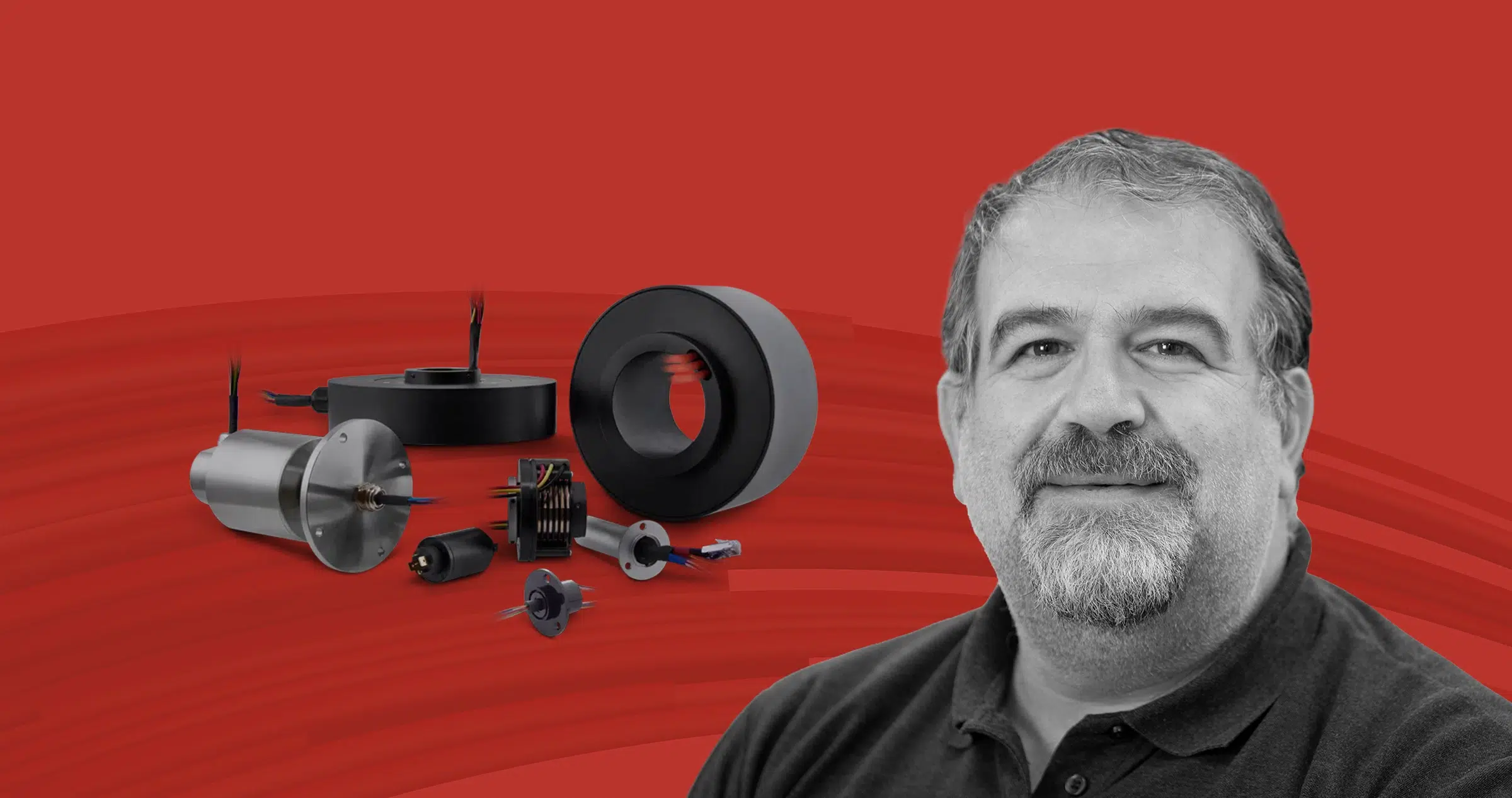
Welcome back to Servotecnica Slip Ring Spotlights, our interview series offering a behind-the-scenes look at those driving innovation in slip ring technology here at Servotecnica. In this edition, we sit down with Riccardo Francazi, Research & Development Team Manager at Servotecnica, to explore what it really means to integrate a slip ring into a machine and why the decisions made at that stage define everything that follows.
Q: Riccardo, thanks for taking the time. Could you tell us a bit about your background and your role at Servotecnica?
Of course. I’ve been with Servotecnica for eleven years now, starting out as an Application Engineer before moving into my current role leading the R&D team. That path has been useful, because I spent several years working directly with customers on application development and integration challenges before shifting focus to the product side. It means I understand both perspectives fairly well.
My day-to-day now involves guiding the development of new solutions, but integration questions still come to my desk regularly. The earlier we get involved in a customer’s design process, the better the outcome tends to be, and that hasn’t changed regardless of which side of the table I’m sitting on.
Q: When customers come to you with an integration question, what is usually at the centre of that conversation?
Most of the time, they already know they need a slip ring. What they’re trying to figure out is where it fits and how it behaves once it’s inside the machine. Those are two very different problems, and both matter.
The first is a mechanical question: how does the slip ring sit within the overall geometry, how is it mounted, how does it interact with the shaft, the frame, the surrounding components? The second is a system-level question: how does power flow through it, what signals are passing across the rotating interface, and what happens to signal quality and reliability under real operating conditions?
When both questions are answered together, early and with the right information, integration tends to go smoothly. When they’re treated separately, or left until the end, we start to see problems.
Q: What are the most common integration mistakes you see in practice?
The most frequent one is treating the slip ring as the last component to be specified. The machine is designed, the rotating structure is defined, the electrical architecture is laid out, and then someone realises a slip ring needs to fit into a space that was never actually designed for it.
At that point, the constraints are already fixed. You’re trying to squeeze a solution into an envelope that wasn’t planned with the slip ring in mind. That often leads to compromises: a unit that is not quite the right geometry, or a mounting arrangement that is not ideal for long-term reliability.
The second mistake is mixing signal types without a plan. Engineers sometimes add circuits incrementally, a power channel here, a sensor line there, maybe a high-speed data line later, without thinking about how those channels interact electrically. Inside a slip ring, if power and sensitive signals are not properly separated and shielded, you create noise and interference problems that are very difficult to solve once the design is locked.
Both of these issues are avoidable, but they require thinking about the slip ring as part of the system, not as a component that can be dropped in at the end.
Q: Let’s talk about the mechanical side first. What are the key integration considerations from a purely physical standpoint?
The geometry of the machine is the starting point. Slip rings are fundamentally cylindrical components that rotate around an axis, so the first question is always: where is that axis in the machine, and what space is available around it?
If there is a central shaft, a through bore slip ring is often the most natural architecture. It mounts onto the shaft, allows other services to pass through the centre, and keeps the integration clean. We work with through bore designs across many industries, robotics, packaging, rotary tables, wind turbines, precisely because so many machines have a central rotating shaft that needs to become the slip ring’s axis.
If there is no shaft, or the shaft is very small, a capsule style unit might be more appropriate. These are compact, cylindrical, and well suited to applications where the priority is fitting a high number of circuits into a small footprint.
Mounting is another point that deserves attention early. How the slip ring is fixed to the stationary structure affects its alignment, its torque reaction, and its long-term stability. A slip ring that is mounted poorly, even slightly misaligned, will wear faster and can introduce electrical noise that has nothing to do with the component itself. We always ask to see the mounting arrangement, not just the dimensional envelope.
Q: And from the electrical side, what should engineers be thinking about when routing power and signals through a rotating interface?
The fundamental principle is that a slip ring should be treated as a mixed-signal system, not a collection of independent wires that happen to share a housing. Everything inside interacts, and the layout decisions you make determine whether those interactions are benign or problematic.
The most important thing is to understand what you are actually transmitting. Power channels, analogue sensing lines, digital control signals, high-speed data: each of these has different characteristics, different sensitivities, and different requirements in terms of shielding and separation. When they are all present together, the internal architecture of the slip ring needs to account for that.
At Servotecnica, we design shielding, grounding strategy, and physical channel separation into the slip ring from the beginning, not as an afterthought. The goal is that the rotating interface is as electrically transparent as possible, so that signals arrive at the other side of the rotation as cleanly as if there were no rotating interface at all.
Where engineers get into difficulty is when they keep adding circuits to an existing layout without revisiting the overall electrical architecture. That is when you start hearing about intermittent behaviour, noise on sensor lines, or unexplained signal degradation. Problems that are often blamed on the slip ring but are actually caused by the system around it.
Q: Can you share a real integration project that illustrates how these principles play out?
One project that comes to mind involved a packaging system running at continuous high speed. The customer had a rotating assembly that needed to carry both power for heating elements and signal lines for temperature monitoring. The space available inside the rotating structure was very limited, and the machine ran essentially twenty-four hours a day.
The challenge was not just fitting the slip ring into the space. It was ensuring that the power channels and signal channels could coexist without the power influencing the temperature sensor readings. In a machine running continuously at speed, even small noise problems on the sensor lines translate directly into process quality issues.
We worked with the customer from an early stage to define a solution that physically separated the power and signal circuits within the slip ring and used appropriate shielding. The mounting was designed together with the machine frame so that the reaction torque was properly managed. The result was a slip ring that integrated cleanly, ran without maintenance for the full operating cycle, and did not require any changes to the machine control system to compensate for electrical interference.
That kind of outcome is only possible when integration is treated as a design problem, not an installation problem.
Q: What role does the operating environment play in integration planning?
A much larger role than most engineers initially expect. The environment determines not just what protection the slip ring needs, sealing, enclosure rating, material selection, but also how the slip ring behaves mechanically and electrically over time.
Temperature is a good example. A slip ring operating in an environment with large temperature swings will experience differential expansion between components. If that is not accounted for in the mechanical design and material selection, you get changes in contact pressure, changes in friction, and eventually reliability problems that look like contact failures but are actually structural.
Vibration is another one. Many industrial machines generate vibration that propagates through the frame into the slip ring mounting. If the mounting is not designed to manage that vibration, or if the slip ring itself is not rated for the vibration level, contact quality degrades over time. Our engineering team always asks about the vibration environment, because it is one of the factors that most frequently surprises customers who are focused primarily on electrical specifications.
For harsh environments, washdown areas, outdoor installations, corrosive atmospheres, the sealing and housing selection becomes critical. Servotecnica produces IP65-rated units for exactly these conditions, and we have experience with stainless steel housings and special surface treatments where chemical exposure is a concern. But the protection level has to be specified at the design stage, not added later.
Q: What is your single most important piece of advice for engineers beginning a slip ring integration project?
Start the conversation early, and bring the full picture with you.
When a customer comes to us with a complete description of their application, the mechanical geometry, the electrical requirements, the operating environment, the duty cycle, the service access constraints, we can provide a solution that actually fits the machine rather than one that has to be worked around.
The more detail we have upfront, the fewer compromises are needed. And in integration, compromises have a way of accumulating: a slightly awkward mounting leads to faster wear, faster wear leads to unexpected downtime, unexpected downtime leads to maintenance interventions that were never planned for.
The slip ring should be an enabling component, the part that makes continuous rotation possible without limiting what the machine can do. When the integration is done properly from the start, that is exactly what it becomes. Over thirty years in this field means we have almost certainly encountered a similar challenge before, and that experience is something we put directly at the customer’s disposal.